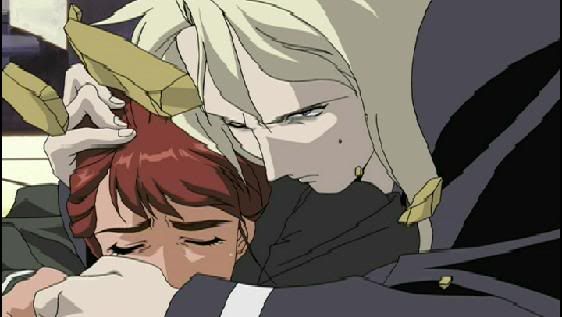
But what really caught my attention at first was the same reason Visions of Escaflowne and Neon Genesis Evangellion caught my attention at first: the Characters. Especially the lead characters. They felt like real, living, breathing, thinking, and emotional people. They weren't badasses with a fatal flaw. They weren't cool and collected. Like it or not, NGE was probably the first anime to start this trend, and I do enjoy this type of thing.
But as we move along, this is where I felt NGE lagged behind the other two. Shinji really doesn't change until very late in the series, and he can get grating. Where as in VoE, the characters do slowly change, often subtly. By the time the first arc finishes in TK (episode 14), it had, to me, equaled VoE in my most favorite anime. I had, so far, like the story better in VoE, but the characters in TK brought it up there.
And to my amazement, I see 31 more episodes to go! So I continue with some giddiness and wonder. And TK delivered. And boy did it. But the first time I watched it, I really couldn't fathom why I loved it.
I mostly figured it out a few months ago, but I was never able to put it into words. I mean, this series does alot of little things right. But that will only make me enjoy it, and many other series do alot of little things (and sometimes more little things) right. But I couldn't explain what it was that made this series so special.
Until a week ago when "slippy" on the animeNFO.com forums typed up the following post:
Those last two paragraphs nailed it on the head for me. And this is why I loved Twelve Kingdoms.Yeah, when Rosso mentioned his interest in serious Asian film directors, I started plugging JK to him big-time. Arilou mentioned the lack of sociological detail in anime, I also plugged this show for that too.
There's a slightly patronizing ongoing commentary on Chinese culture/history that Juuni Kokki mantains, throughout the show. I let it go because, well, this is the Japanese view of historical China, and naturally if anime were produce by Chinese directors, you would see an equally biased view. Anyhoo . . . it's actually interesting that this show would be sophisticated enough to have such a view. I can see where the original novels were culturally attacking Japanese xenophobia and the loss of hope during their recession . . . but the way the original author projected everything onto a feudal [China] made me go reflexive a bit.
Part of JK's beauty is, in recognizing the traditional Asian notion of life's transience in our coming-of-age, 12 Kingdoms elevates itself as a post-tragic spin on life. I always felt the most tragic part of Juuni Kokki actually came in the first 1/3 of the show. Even though the female protoganist "wins", the protoganist also loses. What a cost to pay for your coming of age. This is usually where most anime/manga-style fiction would probably end with the coming-of-age of our female protoganist.
But this story goes on. And, by the end, we experience the circle of rise and fall again and again, sort of the evitable repetition of chance, coincidence, and connection that makes our life recognizable and melancholy to us. Which is to say, that Juuni Kokki is less about one girl's growing up phase, but about what it means, really, to live. To know that we live without real endings and beginnings; to let go of self-pity and useless memories and to know the earth from which you came and make your place.
The most courageous thing you can do is to live. And 12 Kingdoms, rather like Zhang Yimou's earlier work, details just how hard that can really be.
EDIT: Bolded part of quote that was most relevant.


 that's exactly why I luv 12k.
  Its a reason/special factor that's so difficult to put down in words especially my English aint very good. -_-||